Fund the Fight
The wind industry deploys armies of paid advocates, lobbyists, and acoustic consultants. On the other side: thousands of families labelled neurotic, dead birds and whales on coastlines, and one engineer with a spectrum analyser.
Darrell Huff identified the techniques in 1954: the truncated graph that exaggerates small differences, the sample chosen to produce the desired result, the average that conceals the distribution, the correlation presented as causation, the impressive decimal place that implies precision that does not exist. Every one of these techniques appears in wind turbine noise assessments submitted to regulators worldwide. The mathematics is not wrong. The conclusions are.
⚛ The Inventor's Experience — How Establishments Resist Inconvenient Evidence
The Ward Effect® technology required 8 examination reports over 2.5 years before the New Zealand Patent Office granted it. The Korean PCT office examined the same claims and granted instantly. Same invention. Same evidence. Different willingness to accept what the evidence showed.
The technology was demonstrated to a Professor of Physics. He filled a whiteboard with equations and declared: "It cannot work." When the apparatus ran and the effect was unambiguously visible, he left the room without a word. He did not update his equations. He did not acknowledge what he had seen. He left.
This is not unusual. It is the standard response of an establishment to evidence that contradicts its prior conclusions. The wind turbine noise literature shows the same pattern at institutional scale: thousands of complaints, consistent symptom profiles across unconnected jurisdictions, independent researchers finding the same effects — and a regulatory framework that responds by tightening the definition of what counts as evidence until the evidence disappears.
The correct scientific method is simple. The null hypothesis: "Vibrations in a building will not decrease when a wind turbine becomes inactive." Measure vibrations while the turbine is running. Measure again when it stops. In even one house where vibrations decrease when the turbine stops, the null hypothesis is disproved. The conclusion is plain: the measured vibration stops when the wind turbine stops. One measurement. Provable, disprovable, replicable.
Because the measurement is single and clear, the experimenter can freely vary frequencies and measurement methods — each variation either confirms or challenges the result. That is Design of Experiments. That is science.
The industry does the opposite. It constructs a chain of calculations — each step conditional on the last — with one false assumption embedded early in the chain. A-weighting is that assumption. It is a filter mathematically incapable of registering infrasound. Every calculation that follows is technically correct. The final result was always going to be zero. A blackboard full of equations. Showing nothing. By design.
I went to my doctor five times in two years. I was told I was anxious. I was told it was stress. I was told to see a therapist. The turbine was running 800 metres from my bedroom window the entire time. When it stopped for maintenance, I slept for the first time in eighteen months.
— Rural resident, 800m from turbine. Story representative of thousands documented in complaint registers worldwide.Thousands of families living near wind turbines report identical symptoms across unconnected countries: sleep disruption, headaches, pressure sensations, cognitive impairment, anxiety, cardiovascular stress. The industry response is uniform: the measurements show compliance, therefore the symptoms are psychosomatic. The families are neurotic. The measurements use A-weighted sound levels. Darrell Huff would recognise the technique immediately.
🐳 Whale Strandings — The Untested Question
The honest scientific position on whale strandings near offshore wind installations is this: the cause is unknown, because it has not been tested. Whales strand for many reasons in locations with no wind turbines. They also strand during and after offshore wind installation surveys. Without a controlled experiment — stranding rates before installation, during installation, after installation, at comparable coastlines without installation — no conclusion is possible in either direction. "No evidence of harm" from a study that never tested the mechanism is not evidence of no harm. It is the absence of an experiment.
A 2024 study examined humpback whale strandings near offshore wind development areas and found no statistical excess. This finding has been presented as settling the question. It does not. Humpback whales are one species. Defining the study population as humpbacks allows all other whale species strandings to fall outside the scope — excluded by definition, not by evidence. The species selection is the false assumption embedded early in the chain. Every calculation after it is technically correct. The conclusion covers one species. It is presented as covering all whales.
Six Sigma requires starting at the first principle. Not "do wind turbines harm whales" — that is already a conclusion. The correct first question is: How do whales navigate?
The Design of Experiments question follows immediately: What do offshore wind turbines produce that could affect electromagnetic navigation? Subsea power cables carrying high-voltage alternating current — generating electromagnetic fields along every metre of their length, across hundreds of kilometres of seabed, in precisely the frequency ranges used by marine mammals for navigation.
The investigation follows two sequential null hypotheses. The first is already settled by physics.
Null hypothesis 1: "Subsea wind turbine cables do not produce electromagnetic fields."
Result: Disproved. Faraday's law. Any cable carrying electrical current generates an electromagnetic field. Subsea wind turbine cables carry high-voltage alternating current across hundreds of kilometres of seabed. The field exists. This is not contested. It is measurable. It has been measured. Hypothesis 1 is closed.
Null hypothesis 2: "Subsea wind turbine cables cannot locally affect the electromagnetic field used by whales for navigation."
Result: Never tested. Not once. No measurement of field intensity along cable routes relative to the Earth's background magnetic field. No study of whale behaviour in the vicinity of energised cables versus de-energised cables. No correlation of stranding locations against cable crossing points on migration routes. The question has never been asked in a form that could produce an answer. The industry has declared it settled without testing it.
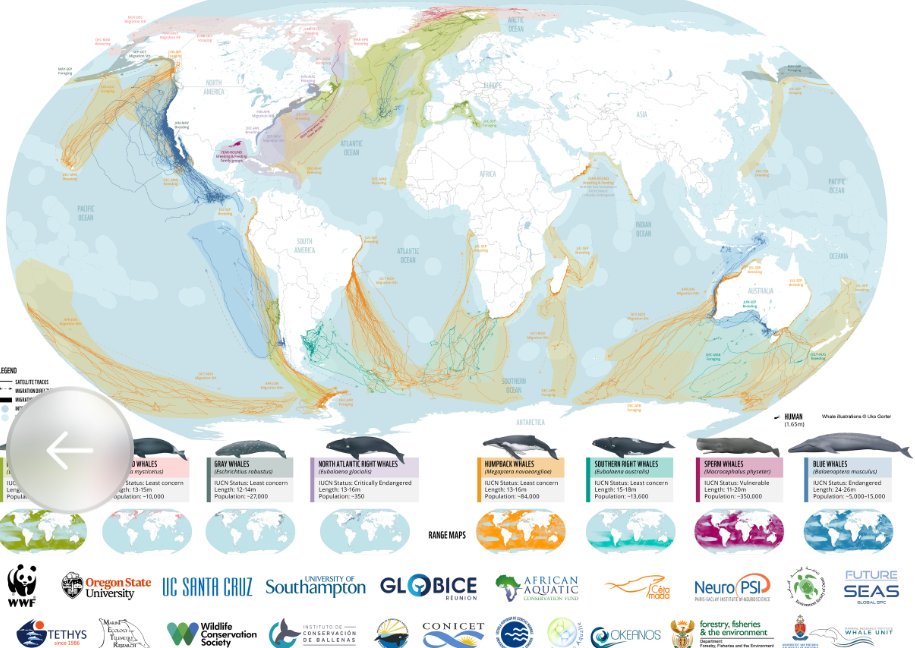
This map shows where whales go. Subsea cable routes from offshore wind farms are public record. Whale stranding locations and dates are held in national databases. A simple correlation analysis — three datasets, one week of work — would establish whether strandings increase where subsea cables cross migration routes. No laboratory. No special equipment. No complex equations. Plot the cables. Plot the migration routes. Plot the strandings. Look.
2. Where do whales migrate?
3. Where do strandings occur — and when?
If strandings correlate with cable crossings of migration routes, the null hypothesis is disproved. If they do not correlate, the null hypothesis stands. This analysis has never been done. The industry has declared the question settled without asking it.
This could be completed within a week with one competent research assistant. The obstacle is not scientific complexity. It is that there is no single global whale stranding database. Data is fragmented across national networks, citizen science platforms, and organisations that do not share records. Coverage is strong in the US, Europe, Australia, and New Zealand — and sparse or absent across most developing coastal nations. A global pattern cannot be assembled. Therefore a global conclusion cannot be challenged. The fragmentation of data is not a natural limitation. It is the condition under which "no evidence of harm" remains permanently defensible. Darrell Huff would recognise it. He called it the sample chosen to produce the desired result.
🐖 Design of Experiments — The Bat Test
Bats use echolocation. They are not perfectly adapted to avoid static structures — they do strike towers, blades, and nacelles when a turbine is stationary. That is the control measurement. That is the baseline.
Null hypothesis: "Moving blades cause no additional bat deaths beyond those recorded at a stationary turbine."
When the blades rotate, two things happen that do not happen at the stationary control: bat strike rates increase, and ruptured bats are found — bats with internal haemorrhage and no external strike marks. Barotrauma. The pressure drop at the blade tip causes fatal internal injury without physical contact. A bat can fly through the swept area and die without touching anything.
The null hypothesis is disproved. Moving blades kill bats by a mechanism — barotrauma — that is entirely separate from, and additional to, the baseline collision rate with static structures. The difference between the control measurement and the test measurement is the harm caused by blade movement alone.
The industry does not do this experiment. It counts carcasses under rotating turbines with no stationary control, no baseline, and no accounting for ruptured bats that show no external marks. It then applies a search radius correction factor — a further calculation in the chain — that was derived from studies of birds, not bats. The final number is precise. It is also meaningless. Darrell Huff would recognise it immediately.
The acoustic assessment demonstrates Darrell Huff's technique with textbook precision. Three statements, each presented as fact:
2. Bats use ultrasound for navigation.
3. Therefore wind turbines cannot harm bats.
Statements 1 and 2 are true. Statement 3 does not follow from them. What has actually been proved is only this: wind turbines cannot harm bats through ultrasound interference. That is one pathway. One mechanism. Measured once.
What has never been measured: barotrauma from blade tip pressure drop. Disorientation from infrasound in the rotor zone. Direct blade strike rates against a stationary control. By presenting the conclusion as "cannot harm bats" — with no qualifier, no scope limitation, no acknowledgement of unmeasured pathways — every other harm mechanism is declared disproved without ever being tested.
This is the scam. Not a false measurement. Not incorrect mathematics. A true conclusion about one thing, silently expanded to cover everything. Huff identified this in 1954. The unwarranted inference — the leap from what was measured to what was never measured, presented as if the two are the same thing. The assessment passes peer review. The regulator accepts it. The bats continue to die. And any researcher who raises barotrauma is told the matter has already been studied and settled.
The measurement is chosen because it cannot find the harm. Every subsequent calculation technically correct. Result always zero. A blackboard full of equations. Showing nothing. By design.
Apple iOS & macOS Development
WardScope® runs on Windows PC and Android. Apple iOS is 55% of the US smartphone market — the primary jurisdiction for regulatory reform. An affected American family with an iPhone has no access to WardScope® Mobile. This fund changes that.
-
WardScope® Mobile for iPhone & iPad Full Flutter port — real-time FFT, GPS tagging, memory slots, 33-language support. Same $9.99 price as Android. Available on the App Store.
-
WardScope® PC Analyzer for macOS Native macOS version of the full analysis suite — all weighting curves, Organizer, export. Same $99.99 price as Windows. Available on the Mac App Store.
-
Apple Developer Program, Certificates & Review Annual Apple Developer membership, code signing, TestFlight beta infrastructure, notarisation, and App Store review compliance.
⚠ Honest Assessment
Independent cost estimates put Apple platform development at $85,000 to $135,000. WardScope® will be sold on iOS and macOS at the same price as Android and Windows — $9.99 Mobile, $99.99 Full Suite. At those prices, recouping development cost requires tens of thousands of sales. This is unlikely to be financially viable on sales revenue alone. The Apple versions will be built if this fund reaches target. They will be priced at what families can afford, not at what justifies the development cost. That is a deliberate choice. Your donation makes it possible.
| Platform | Development Estimate | Sale Price |
|---|---|---|
| WardScope® Mobile — Android (existing) | Complete | $9.99 |
| WardScope® PC Analyzer — Windows (existing) | Complete | $99.99 |
| WardScope® Mobile — iPhone & iPad | $45,000 – $70,000 | $9.99 (same) |
| WardScope® PC Analyzer — macOS | $40,000 – $65,000 | $99.99 (same) |
🧠 Why AI Cannot See What a Single Experiment Can Prove
An AI asked about wind turbine harm will defend the industry position — not because it is corrupt, but because its training data is the public scientific literature. That literature contains thousands of peer-reviewed papers on A-weighted noise assessment, regulatory compliance methodology, and complex acoustic modelling. It contains almost nothing on the simple null hypothesis: measure vibrations while the turbine runs, measure when it stops, compare the two numbers.
The simple experiment is absent from the literature because it was never published. It was never published because it was never funded. It was never funded because the result was predictable and unwanted. AI reflects the literature. The literature reflects the funding. The funding reflects the industry. The circularity is invisible to the AI because the gap — the missing experiment — does not appear in any document it was trained on. The absence cannot be seen. Only the presence of complexity can.
This is why Design of Experiments is so threatening to the established framework. It does not require a literature. It does not require funding. It does not require peer review or complex mathematics. It requires a question, a measurement, and a control. One house. One turbine. Vibrations measured while running. Vibrations measured when stopped. Any difference disproves the null hypothesis. The experiment can be run by an affected family with a $9.99 app on their phone.
Ask an AI about whale strandings near offshore wind installations and it will cite Thorne & Wiley. Ask it about subsea cables and electromagnetic navigation disruption and it will find nothing — because the research does not exist. No study. No paper. No dataset. The AI is not ignoring the question. It is accurately reporting that the question has never been investigated. But it then draws the same conclusion the industry draws: no evidence of harm. It cannot see that the absence of research is itself the finding. The question was never asked because the answer was never wanted.
Worse — the more studies that cite Thorne & Wiley, the more entrenched the AI position becomes. Each citation adds weight. The original study's scope — one species, no electromagnetic pathway, no controlled experiment — is never re-examined. It simply accumulates authority with each reference until it becomes, in the AI's training corpus, settled science. The simple unanswered question — do subsea cables locally distort the electromagnetic field used by whales for navigation — never appears. It generates no citations. It has no weight. It does not exist.
An independent researcher with a spectrum analyser and a null hypothesis is more dangerous to this industry than a thousand academic papers. The papers operate inside the framework. The null hypothesis operates outside it. The framework cannot dismiss a result it was designed never to produce.
Website Developer & Manager
The wardscope.com website is currently built and maintained by the same person who invented the technology, filed the patents, wrote the software, and is conducting the research. That is not a sustainable division of labour for a campaign of this scope.
-
Dedicated Web Developer A skilled person to take full ownership of wardscope.com — rebuilding pages to professional standard, maintaining consistent navigation and branding, and implementing new content without bottlenecking the inventor's research time.
-
Content Pipeline & SEO Regular publication of technical updates, case studies, community stories, and regulatory developments — content that keeps wardscope.com visible in search results and relevant to journalists, legislators, and affected communities searching for evidence and tools.
-
Campaign Infrastructure Email outreach systems, press kit hosting, downloadable evidence packages, and community submission templates — infrastructure that multiplies the impact of every piece of evidence WardScope® produces.
Full-Time Campaign Advocate
The wind industry does not leave advocacy to chance. Every major developer, every industry association, and every government renewable energy agency employs full-time communications staff whose job is to attend hearings, brief journalists, respond to complaints, and maintain the public narrative. They are paid. They are organised. They are relentless.
On the other side of this fight: thousands of families with symptoms they cannot prove, birds that cannot speak, whales that cannot testify, and one researcher with a spectrum analyser and a patent.
They sent a consultant. He had a briefcase and a laptop and a noise meter that couldn't hear what we were hearing. He stood in our paddock for forty minutes, told us the measurement showed compliance, and drove away. That was the end of the investigation.
— Farmer, rural Victoria, Australia. Waubra Wind Farm complaint register.-
Media & Press Liaison A dedicated person to pitch stories, respond to journalist enquiries, coordinate with documentary makers, and ensure that every new piece of evidence receives the media attention it deserves — before the industry's communications team frames it first.
-
Regulatory & Political Engagement Attending public hearings, submitting to consultations, briefing Congressional staff, coordinating with senators and representatives on specific legislative proposals — the unglamorous but essential work of changing policy from the inside.
-
Community Network Coordinator Connecting affected communities across jurisdictions, sharing evidence templates, coordinating legal strategies, and ensuring that local measurements become part of a national and international pattern that regulators cannot dismiss as isolated anecdote.
-
Social Media & Public Narrative Daily presence on platforms where the wind industry is also active — countering industry talking points with documented evidence, sharing community stories, and making the case to the public that A-weighted measurements are an instrument of regulatory capture, not a measure of safety.
💬 Why This Is the Most Important Fund
The science is settled. The evidence exists. What is missing is someone whose full-time job is to make sure that evidence reaches the people with the power to act on it — and keeps reaching them, persistently, until they do. The wind industry has hundreds of those people. This campaign currently has none. One full-time advocate, properly resourced, changes the trajectory of this campaign more than any single piece of research.
Choose a Fund & Donate
Secure payment via PayPal · No PayPal account required · All currencies accepted
To specify allocation or arrange bank transfer: [email protected]